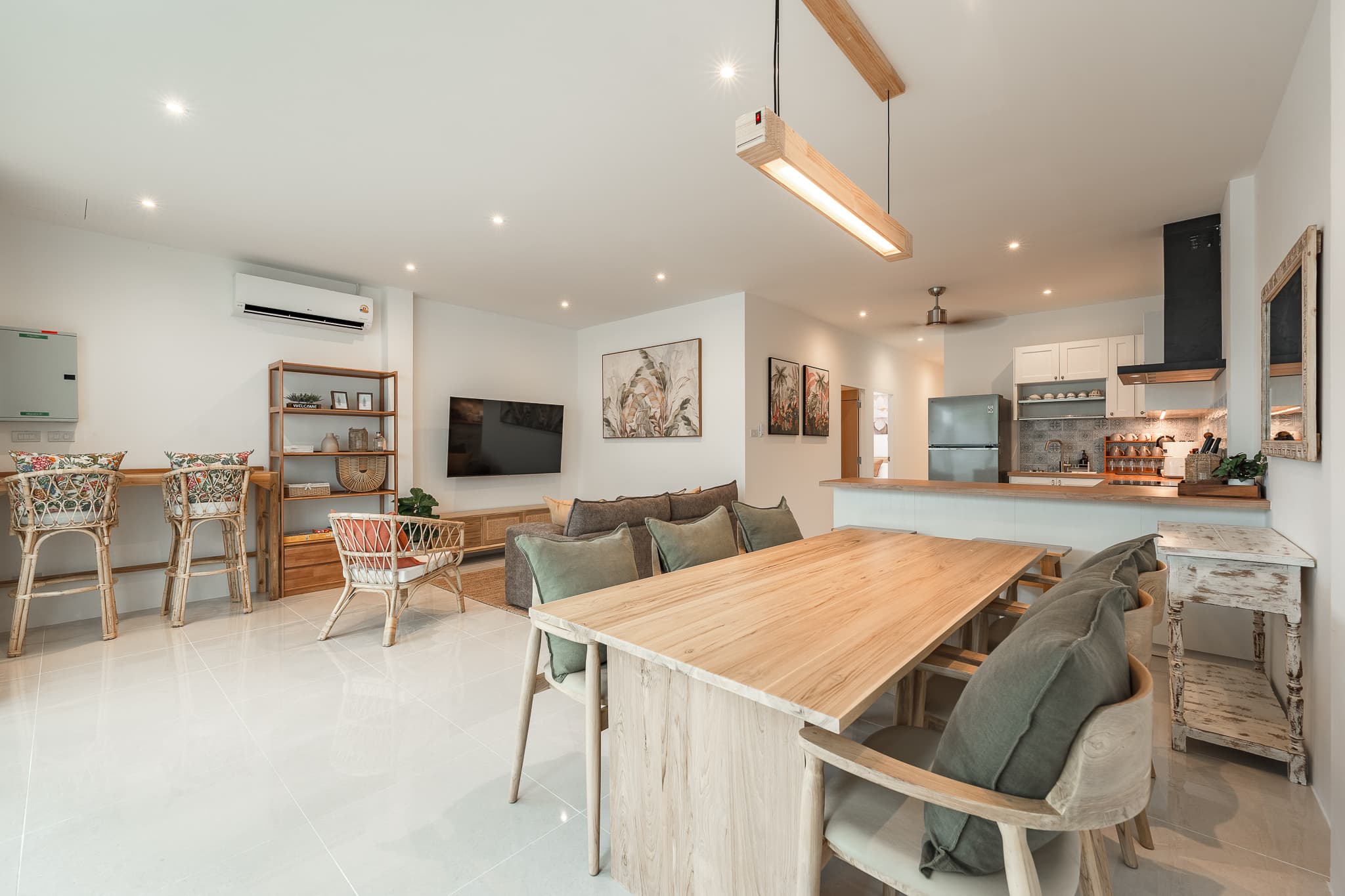
Air conditioning
Villa air conditioning in Phuket: servicing, faults and who pays
It is the item that breaks most often in a Phuket villa and the one owners understand least. This is what it actually needs, what the warning signs look like before a guest calls, and which costs sit with you.
Why it fails here
A Phuket villa asks far more of an air conditioner than a European house ever did.
Owners arrive with a European sense of what air conditioning needs, which is roughly nothing. Here it is the most serviced item in the building, and the one that produces the most guest complaints.
It never really stops
In a European summer a split unit runs hard for a few weeks a year. Here a bedroom unit runs most nights of the year. Even in the months people call cool the nights sit in the mid twenties with the humidity barely moving, and those are exactly the months the house is full. In a villa that rents it also runs all day, for guests who never switch anything off. The compressor accumulates in one season what a temperate installation does in several. Everything else on this page comes back to that one fact.
Humidity is the real load
An air conditioner works by passing room air over a coil colder than the dew point, so it strips moisture out at the same time as it takes heat away. In this climate that second half of the job is most of the work. That means litres of water a day condensing on a cold coil, collecting in a tray and leaving through a pipe. Wet metal in a warm room catches dust, dust feeds biological growth, and growth blocks things. A dry climate never builds that layer, which is why European service intervals do not transfer.
Salt travels further inland than owners expect
Phuket is a narrow island and the sea breeze carries salt well past the first row of houses. It settles on the thin aluminium fins of the outdoor unit and corrodes them into a grey powder. A condenser on an exposed terrace ages visibly faster than the same model in a sheltered courtyard. Corrosion is one of the places refrigerant leaks start, not the first one (that is the flare joints, further down this page), but the one you can actually slow down. A fresh water rinse at each service is not cosmetic.
Dust, cut grass and whatever is being built next door
Leaf fall, red dust off unsealed roads, clippings from the garden team and construction dust from the plot next door all arrive on the same filter. Building work is more or less permanent somewhere on any Phuket estate, and it does not ask your permission. A house that would stay clean for months in Europe delivers a grey filter here in a fortnight.
The decline is invisible until it is a complaint
Cooling capacity falls slowly enough that anyone living with it adjusts without noticing. A guest arriving on a Friday does not adjust: they compare the bedroom to the photographs and to every hotel they have stayed in. That is why air conditioning problems in a rented villa surface as reviews rather than as maintenance requests. By the time somebody complains, the machine has usually been getting worse for months.
Filters
The five minute job that decides most of the rest.
If only one thing on this page gets done, make it this one. A blocked filter is not a small inefficiency: it is the first step in nearly every expensive air conditioning failure we are called to.
What a blocked filter actually does
Airflow across the coil drops. With less warm air passing over it the coil runs colder than designed, and in this humidity it starts to freeze. A frozen coil blows nothing at all, so the guest reports the unit as broken. Meanwhile the compressor is running on a suction pressure far below what it was built for. On a sealed compressor the motor is cooled by that suction gas, so with the flow collapsed it simply overheats. Then the ice melts, and refrigerant that never boiled off comes back down the line as liquid to a machine designed to pump gas. That is how a filter nobody washed ends up costing a compressor.
The real frequency in a villa that rents
Every few weeks, not twice a year, and more often on the units running every night. In practice the bedroom filters in a house with guests arriving back to back want checking at the turnaround rather than on a quarterly plan. Owners find that implausible until they are shown the first one. It takes a housekeeper a few minutes per unit and it is the cheapest maintenance in the building by a wide margin.
Washing them properly, and drying them properly
Cold water, a soft brush, no detergent that leaves a film, and no pressure washer anywhere near a plastic mesh. The part people get wrong is the drying. A damp filter pushed back into a dark box in a humid room grows exactly what you would expect, and that is usually where the smell on start up comes from. Dry them in the shade until they are genuinely dry, then refit. Not in full sun, which distorts the plastic frame until it no longer seats properly, and a filter that does not seat lets unfiltered air past the edge of it straight onto the coil.
Do not leave it to the guest
Some owners put filter cleaning in the house manual. It does not happen, and the one guest who attempts it will crack the front panel or refit the filter soaking wet. This belongs to the person who is in the house anyway between stays, on a written checklist, with a date recorded against each unit. If nobody can tell you when a filter was last washed, it was not washed.

The chemical clean
Washing a filter is not cleaning the machine.
The filter catches the coarse dust. Everything finer gets past it and lands on the coil and the fan wheel, where no amount of filter washing will ever reach it. That is a separate job, done with the unit opened up.
What the work actually involves
The casing comes off, a collection bag goes underneath, and the coil and blower wheel are treated with a cleaning agent and rinsed under pressure. The drain tray is scrubbed and the drain line flushed through while the unit is open. The water that comes out is usually black, which is the reason to ask for a photograph of it. A technician who services a split unit in ten minutes without opening it has washed a filter and invoiced a service.
The rhythm that holds up here
Twice a year on the units that run every night in a villa that rents through the season, once a year on the ones that barely run. Owners who use the house themselves for a few weeks can stretch it, but not indefinitely: the growth continues whether or not anybody is in the room. The sensible calendar puts one clean in before high season, so the machines meet November in good condition rather than being discovered in January.
The blower wheel is what a guest smells
The fan wheel inside the indoor unit collects a dark felt of dust bound together by condensation. It is the source of the sour smell that arrives about thirty seconds after switching a unit on, and no spray or deodoriser touches it. It also unbalances the wheel, which is the rattle owners assume is a loose panel. Reaching it means dismantling further than a quick service goes, so it is worth asking specifically whether it was done.
What skipping it costs
A fouled coil cannot transfer heat, so the unit runs longer for the same room temperature and the electricity bill rises without anyone connecting the two. The compressor spends more hours running under a higher load, and hours under load is the main thing deciding how many years it lasts. None of this ever presents as a fault, which is exactly why it gets deferred. It arrives instead as a replacement, and replacing units is the expensive end of villa maintenance.
How to tell it was really done
Ask for a photograph of the wash water and of the coil after rinsing, plus a note of which units were treated. On the houses we run that goes into a maintenance record with the date, so the next visit knows what state it is starting from. It sounds bureaucratic for something as ordinary as a clean. It is also the only way an owner sitting in another country can tell a service from an invoice.
Refrigerant
How to recognise a leak before the room stops cooling.
This is one of the places owners in Phuket pay for the same thing twice, because the standard local answer to a weak unit is to add gas and drive away. A sealed system does not consume refrigerant. If it needed some, it lost some.
There is no normal annual top up
A split system is a closed loop. Gas is not used up, burnt off or worn out in service. A unit that needs charging every year has a leak nobody has looked for, and each visit is paying for the leak rather than repairing it. Any technician who tells you that annual topping up is just normal maintenance has told you what kind of technician they are.
The early signs, roughly in order
The unit runs longer and longer to hold the same temperature, then starts running continuously through the hottest part of the afternoon. The air at the vents is cool rather than cold. Frost appears on the large insulated suction line where it enters the outdoor unit, or on the service valve itself, which is worth knowing because the thin bare pipe next to it is the liquid line and is meant to be warm to the touch. By the time it is blowing warm air it has been leaking for weeks, and it almost always chooses a full house to finish.
Running low is what kills the compressor
Refrigerant carries the oil that lubricates the compressor. A system short of gas runs hot and starved, and the damage accumulates well before the cooling visibly fails. A leak found in August is a repair. The same leak ignored until December is a new unit, bought in a hurry, in the month you least want a technician in a bedroom.
Where they leak
The flare joints at each end of the pipe run, made by hand at installation and then vibrated for years. The outdoor coil, once salt has worked on the tubing. And the pipe run itself where it passes through a wall or a ceiling void, which is the awkward one to reach and the expensive one to repair. Installations rushed by a developer just before handover are over represented in all three.
What a proper repair looks like
The system is pressure tested, usually with nitrogen, until the loss is located. The leak is repaired, the system is pulled down under vacuum to remove moisture and air, and it is then charged by weight rather than by feel: the manufacturer figure, plus the supplement for every metre of pipe beyond the length the unit came pre charged for. In a villa where the condenser was pushed well out of sight for the sake of the view, that supplement is rarely zero, and a machine filled straight off the nameplate goes back into service short. That is hours of work, not twenty minutes. Insist on it, because the alternative is buying gas on a schedule for the rest of the unit’s life.
Water where it should not be
The fault that arrives as a stain rather than as a noise.
Every air conditioner in this climate produces water continuously while it runs. That water has to leave the building through a pipe with nothing pushing it, and that pipe is the most reliably neglected part of the whole installation.
How much water there really is
A bedroom unit running overnight in the wet season pulls a surprising quantity of water out of the air, and a whole villa sends all of it down drain lines not much wider than a garden hose. On the wall units nothing pumps it. It moves on gravity alone, down a fall that somebody set at installation and nobody has checked since. If that fall was wrong, or a pipe has sagged over the years, the tray backs up long before the line is genuinely blocked. On a concealed ducted unit there is usually a lift pump instead, and that pump is a failure point in its own right: a fouled float or a dead motor floods the tray just as effectively as a blocked line, and it happens above a ceiling where nobody hears it.
Why the line blocks
A warm damp pipe plus the dust that slips past the filter makes a slime that narrows the bore and eventually plugs it. It builds quietly through the season and lets go at the worst possible moment, which is generally the week the house is full. Flushing the line is part of a proper service and takes minutes. No owner has ever asked for it, which is precisely why it has to live on the schedule rather than on request.
The false ceiling is where it gets expensive
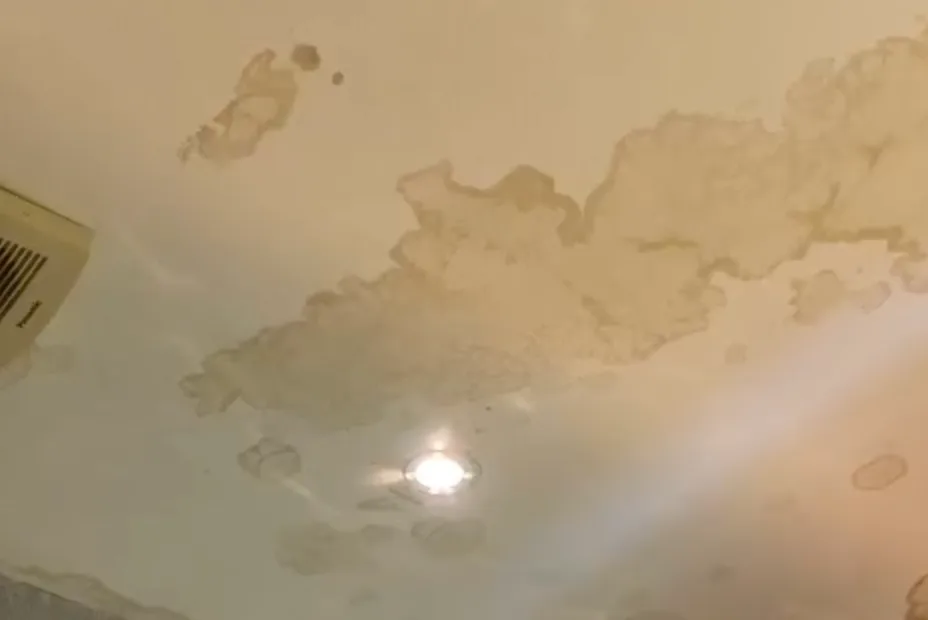
Concealed ducted units sit above plasterboard, so an overflowing tray never drips onto a floor where somebody would notice. It soaks the ceiling first. Owners find out when a brown ring appears above a bed, or when water comes through onto a guest at three in the morning. The repair is then a ceiling, a repaint and often a week off the calendar, all for the sake of a drain flush that costs almost nothing.
Mould in the ducting
Once damp is sitting inside a duct, or in the insulation wrapped around it, growth follows and the whole house smells of it every time the system starts. Guests notice within a minute of walking in and they write it down. Cleaning ductwork properly is a specialist job and not a cheap one, and in bad cases sections have to be cut out and replaced. This is the failure most worth preventing, because the fix is always out of all proportion to the cause.
The cheap protection that is often missing
A float switch on the drain tray shuts the unit down when the water level rises instead of letting it overflow. It turns a ceiling repair into a phone call about a bedroom that stopped cooling, which is a very good trade. They cost little and they are frequently absent on ducted installations here. If your villa has concealed units above plasterboard, ask whether they are fitted, and have them fitted if they are not.
The outdoor unit
Where it was installed decides how long it lasts.
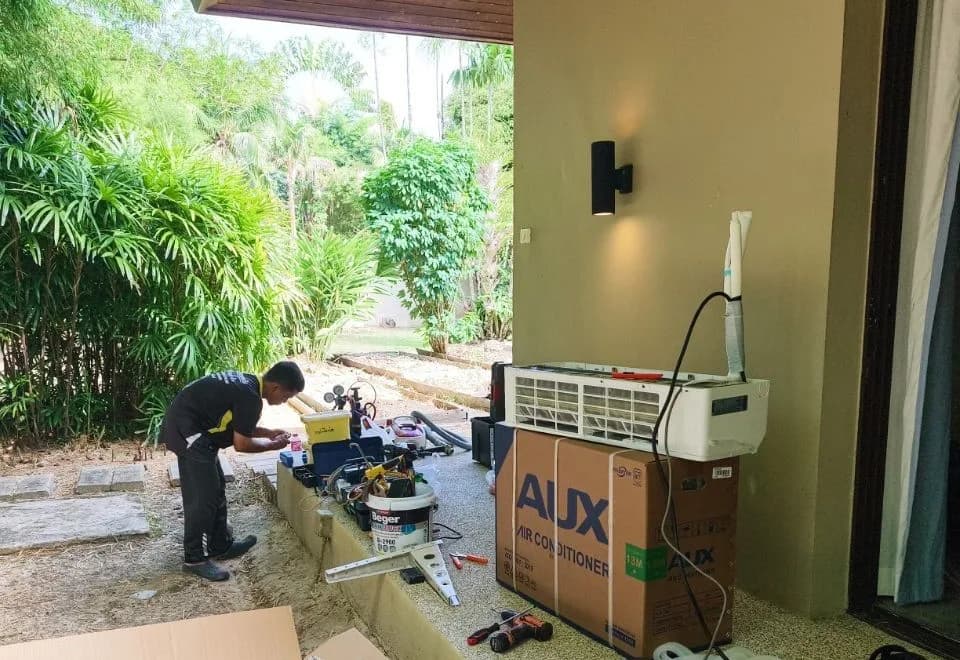
The condenser has one job: move the heat from inside the house into the air outside. Anything that makes that harder shortens its life, and most of it was decided by whoever chose the spot.
Full afternoon sun
A unit asked to reject heat into air that is already baking works harder for the same result, and its own surfaces get hot enough to matter. Shade helps, but only shade that does not obstruct airflow: a solid box built around a condenser is worse than the sun ever was. A simple roof with open sides, well clear of the fan, is what you want. It is one of the few small improvements that noticeably extends the life of the machine.
Too close to a wall
The unit draws air in through the back and sides and throws it out of the front. Put it in a narrow service alley or hard against a garden wall and it breathes its own exhaust, which is why some rooms never quite get cold in the afternoon whatever anyone does indoors. Manufacturers publish minimum clearances and installers in a hurry ignore them. Moving a condenser is not a big job, and occasionally it is the whole answer.
Salt and the fins
The aluminium fins on the coil are extremely thin, and salt air turns them to powder that both blocks airflow and eventually perforates the tubing behind them. A fresh water rinse at every service slows that down considerably and takes a few minutes. On exposed plots near the coast it is the difference between a condenser that lasts and one that starts leaking refrigerant after a few seasons.
Everything the garden throws at it
Grass clippings off the strimmer, leaf fall, frangipani flowers and dust from the drive all pack into the coil from the outside where nobody looks. We have opened up condensers sitting in a bed of cuttings, because the garden team had been blowing debris towards the tidiest looking corner of the plot. Keeping the area clear costs nothing. Telling whoever cuts the grass which way to point the blower costs less.
What lives inside the outdoor unit
The control board sits in a warm dry box with cable holes in the bottom of it, which on this island is an invitation. Ants nest on the board itself and bridge the tracks, and geckos climb in and get across the terminals. What the owner sees is a unit that is simply dead one morning, or an error code that means nothing to anybody, or a breaker that trips every time the compressor tries to start. None of it looks like an air conditioning fault, and a technician who only ever opens the indoor unit will not find it. The defence is unglamorous: the cover refitted with all of its screws, cable entries actually sealed rather than stuffed with a rag, and somebody looking at the board at each visit instead of only at the coil.
The supply it is plugged into
Power here is not always clean. Momentary cuts and voltage dips are ordinary through the rainy season, and a compressor dropped and restarted repeatedly, or an inverter board that takes a surge from a strike somewhere down the road, fails in ways that read as random bad luck. Almost no villa installation has anything standing between the machines and the incoming supply. Surge protection at the consumer unit is a small job compared with a control board, and on a house full of inverter units it is worth asking whether any was ever fitted. The answer is usually no.
What guests do
Sixteen degrees, with the terrace doors open.
This is not a complaint about guests. It is entirely predictable behaviour that every villa on this island experiences, and the job is to design around it rather than be annoyed by it.
Why sixteen does not cool the room any faster
On an older fixed speed unit a thermostat is a target, not a throttle: sixteen does not make it blow harder or colder, it only means the unit never reaches the setting and therefore never stops. On an inverter it does ramp up for a gap that wide, but only for the first few minutes, after which the room is already at the temperature the guest actually wanted and the machine has no reason left to ease off. Either way the setting buys nothing. The room does not get cold any faster. It simply never stops, sails past comfortable somewhere around three in the morning, and the machine spends the night at full load doing it. Almost every guest believes the opposite, and no house manual has ever changed that.
What actually happens at sixteen
On a clean, correctly charged machine, usually nothing dramatic: it runs all night and the room gets too cold. On a machine already carrying a dirty filter, a fouled coil or a low charge, a setting like that is what finally tips it into freezing. The coil sits below zero for hours, moisture freezes onto it instead of draining away, and airflow stops altogether. The guest reports a broken air conditioner. A technician drives across the island, finds a block of ice, waits for it to melt and finds nothing wrong with the machine. That is a call out and half a day spent on a unit that was working perfectly, and it is why the same two or three bedrooms in a house ice up again and again while the others never do. The setting is what triggers it. The condition of the machine is what allowed it.
The open door
A split unit is sized for a closed room. Leave the terrace doors open and it is trying to dehumidify the garden, so it never cycles off, the floor near the doors goes damp with condensation, and on a house left like that through a wet month the marks turn up on the plaster at skirting height. Guests do it because the villa is beautiful with the doors open, which is fair enough. The answer is a conversation at check-in and a house that makes the right choice easy, not a laminated sign nobody reads.
What we do about it
We say it in person at check-in, and we say it as advice about their own comfort rather than as a rule about our equipment: set it around twenty four, keep the room closed, and it will be properly cold within the hour. Where an owner wants it, a controller can be limited so the setting cannot drop below a chosen point. On houses with a lot of glass we watch which units ice up repeatedly, because that usually tells us one room is being run in a way the others are not.
Who pays for that call out
Where nothing was broken, that visit is a running cost on the property, and we would advise against trying to recover it from the guest. Chasing somebody over a frosted coil buys you a bad review and loses you the money anyway. Where there is real damage, a panel pulled off or a unit run with the filter removed, the deposit exists for exactly that and we document it with photographs on the day rather than arguing about it a week later.
Planned work and emergencies
Two different budgets, and it matters which one you are in.
Scheduled work is cheap, predictable and can wait for a convenient day. Emergency work is expensive, and in a villa with guests in it the invoice is rarely the real cost.
What sits on the schedule
Filters at the turnaround. A drain line flush and an outdoor unit rinse at every service visit. A chemical clean on the units that work hardest, planned around your calendar rather than around a fault. And one full check before high season, with every unit run and the temperature drop across it measured, return air against supply air rather than a thermometer held at the grille, and anything marginal dealt with in October instead of January. All of it can be quoted in advance and moved by a week without consequence.
What counts as an emergency
No cooling in an occupied bedroom. Water coming through a ceiling. A burning smell, or a unit tripping the breaker, both of which mean switched off at the board until somebody has looked at it. Those get a technician the same day, Sunday included, which costs more than a weekday visit and is worth every satang of it. Everything else waits for a normal service visit, and we will tell you which one you are in.
What a Sunday failure actually costs here
The labour is ordinary work at a weekend rate, and a Sunday call out costs more than the same visit on a Tuesday. The part is the bigger variable, and it is where the island shows up in the answer. Filters, capacitors, contactors, fan motors and the boards for the brands that sell in volume here are on a shelf in Phuket, so a competent technician fixes it that day. A compressor, or the board for a model somebody imported because it looked good, comes down from Bangkok: that is days rather than hours, and longer across a long weekend or Songkran. Meanwhile a family is sleeping badly in a house they chose over a hotel. A review written in the middle of high season is read by everybody who looks at the listing afterwards, and there is no line for that anywhere in your accounts. That is the entire argument for spending small amounts on schedule.
Who pays for what
The equipment is yours and so is its upkeep. Parts, gas, contractor labour and replacement units are property costs, and they appear on your statement with the contractor’s invoice behind them. Arranging the work, meeting the technician, checking what was actually done and chasing the return visit is management work and is part of what we do. Guest caused damage is documented at the time and handled through the deposit.
Nothing gets spent above your threshold without a call
We agree a figure with each owner above which we ask before spending, and below which we simply deal with it and report. Set it too low and you get messages about a filter; set it too high and you find out about a compressor after the fact. For air conditioning we would rather ring you at an awkward hour than decide for you on a machine that may be at the end of its life. There is a point, usually after a leak has been chased twice, where more repair is money into something that is going to fail anyway. When we reach it we say so, with the service history, and the decision stays yours.
Straight answers
What owners ask us about air conditioning.
How often should the air conditioning be serviced in a villa that rents?
My technician tops up the gas every year. Is that normal?
Why does the air conditioning smell when it starts up?
Is an inverter unit worth it when I replace one?
The air conditioning has failed and there are guests in the house. What happens?
We are not on the island. Who is actually checking any of this?
Reviewed . We update these pages when the practice on the ground changes, not on a schedule.
Where to go next
Our services
- Villa management in Phuket
- Condo management in Phuket
- Airbnb management in Phuket
- All property management services
- Villa care for absentee owners in Phuket
- Rent out my villa in Phuket
- A second opinion on how your villa is being managed
- Villa maintenance and housekeeping in Phuket
- Home property management in Phuket
- About Phuket Property Manager
- Contact a property management company in Phuket
Guides for owners
- Employing villa staff in Phuket
- Off-plan villa handover in Phuket: the snagging inspection
- How to choose a property management company in Phuket
- Self-managing versus hiring a property manager in Phuket
- Short-term rental rules in Phuket: the 30-day question
- Your rental guarantee is ending. What now?
- Switching property manager in Phuket
- Property management fees in Phuket
- The true cost of running a villa in Phuket
- Property management in Phuket for foreign owners
- Mould and humidity in an empty villa in Phuket
- Water in a Phuket villa: the tank, the pump and the day it runs dry
- Salt corrosion in a coastal villa in Phuket
- Villa pool maintenance in the Phuket rainy season
Talk to the person who would look after your property.
No call centre, no sales team. We keep the portfolio small on purpose.