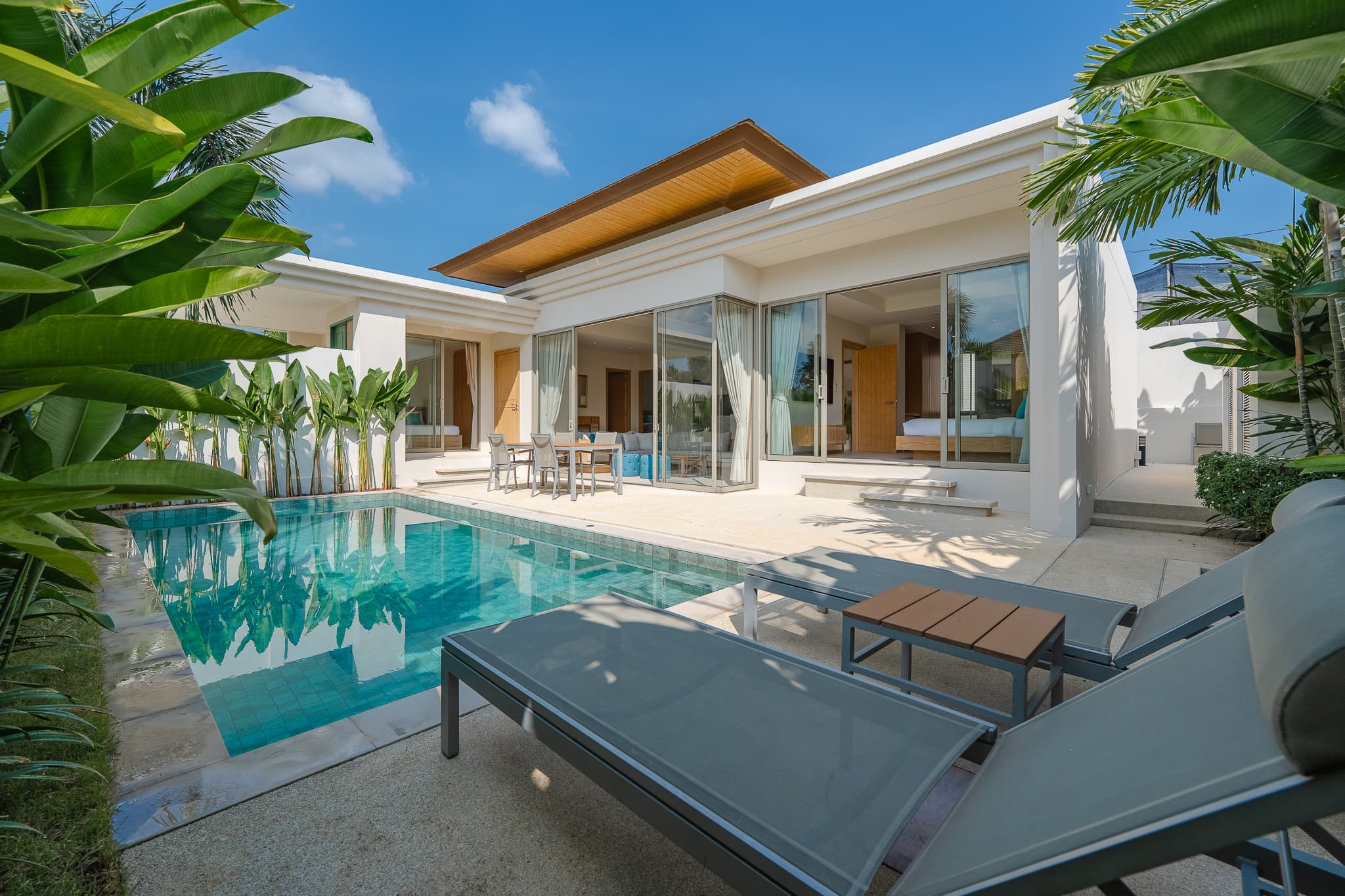
Pool care
Villa pool maintenance in the Phuket rainy season
The pool is the reason most of these houses get booked, and it is the thing that fails fastest when the rain arrives. This is what actually happens to the water, in what order, and what it costs when nobody acts for a week.
The mechanism
Why a pool turns in four days of rain.
A pool is a chemical balance held in place by circulation. Rain attacks both sides of that balance at the same time, which is why water that looked perfect on Friday can be unrecognisable by Tuesday.
Rain dilutes what is protecting the water
Every centimetre of rain falling into the pool is untreated water arriving on top of treated water. It carries no chlorine and no stabiliser, so both are weaker afterwards, and the stabiliser is the thing keeping your chlorine alive under a tropical sun. A heavy monsoon week can lift the level to the coping and push the balance out on its own, before a single leaf has landed. This is the part owners never see, because on the day it happens the water still looks fine.
Rain carries no buffer, so the pH stops holding
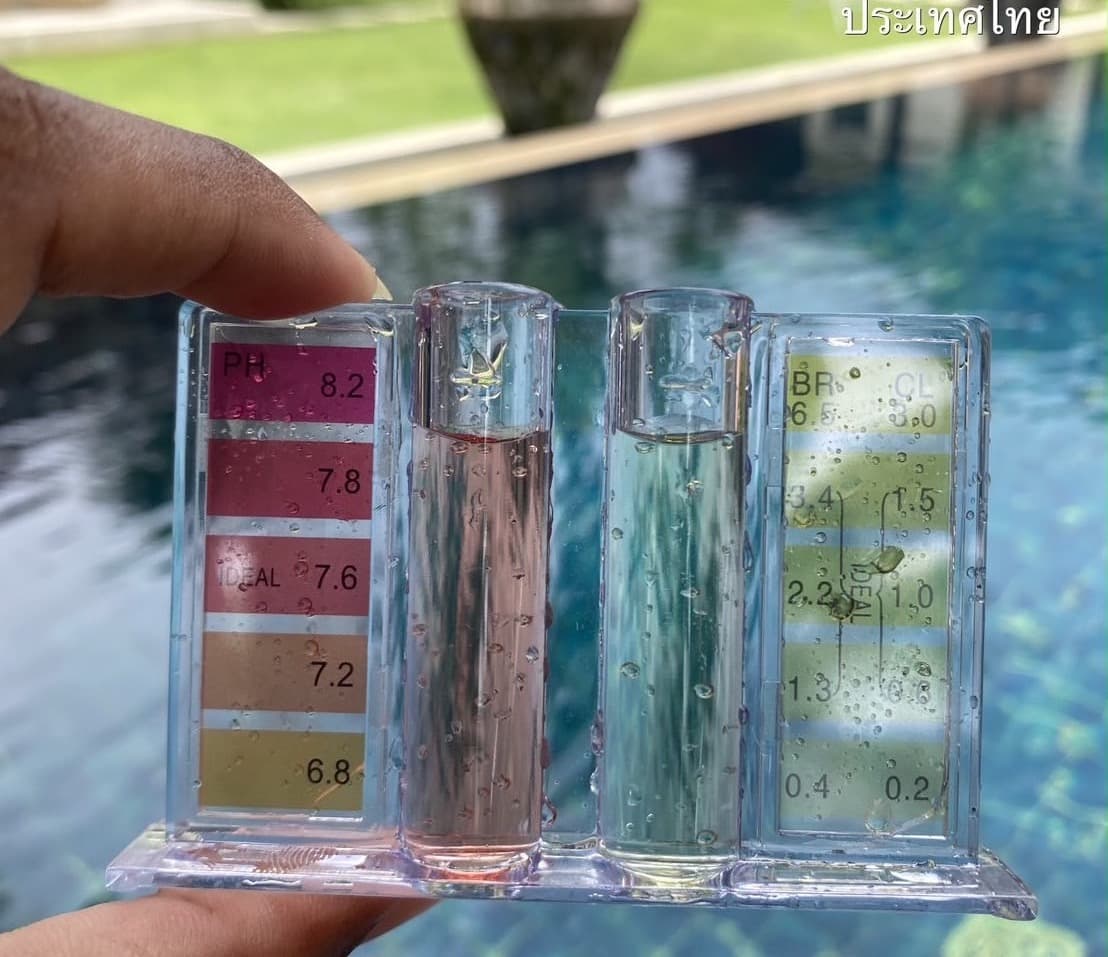
Rainwater is mildly acidic, and that is the part everybody repeats. The part that matters is that it carries almost no alkalinity, so what it really does is wash out the buffer that was holding your pH steady. A pool whose alkalinity has been diluted will not keep a pH you correct: it moves on whatever happens next. Straight after the rain it usually sits low, which is hard on grout, on a pebble finish and on anything metal in the plant room. Then it climbs, because a pool running hard degasses and a spillway or an infinity edge degasses faster, and the high side is the one that costs you sanitation. That is where you hold a perfectly normal chlorine reading and still have water that is barely disinfecting, and where the owner is told the chlorine is fine, which is true and beside the point. The target printed on any pool test kit, roughly 7.4 to 7.6, is not a preference. It is where the chlorine you are already paying for does its work. Put the alkalinity back before the pH, or you will correct the same pH twice.
Leaves and garden debris eat the chlorine
Organic matter is not simply untidy, it consumes sanitiser as it breaks down. A storm strips a mature tropical garden of leaves, frangipani flowers, seed pods and palm litter, and most of it ends up either floating or, worse, on the floor of the pool where nobody looks. What sinks decomposes, releases tannins, marks the plaster and keeps drawing the chlorine down until it is physically removed. The skimmer basket handles the floating half. The half on the bottom needs somebody with a net and a vacuum head.
The garden drains into the pool
Whether the villa is on flat ground or cut into a hillside, the pool ends up at the low point of what immediately surrounds it: the terrace drains towards it, and so do the beds above it. Heavy rain moves soil, mulch and fertiliser across that terrace, and if there is no drainage channel at the coping it goes straight in. Fertiliser is the expensive part, because phosphates are algae food and because runoff arrives with an organic load of its own. A pool taking regular garden runoff does not defy chemistry, it simply eats its chlorine faster than the visit schedule puts it back, and it goes green between visits rather than on the day of one. This is a landscaping problem wearing a pool problem’s clothes, and it is fixed once with a channel and a regrade rather than every wet season with chemicals.
Nothing here ever interrupts algae
The tropical advantage for algae is not that any single day is extreme. It is that no day is different. Phuket sits under eight degrees off the equator, so the longest day of the year is barely an hour longer than the shortest, the sun is close to overhead, and the UV stays strong through heavy cloud. Pool water is warm every month of the year. There is no cold season, no short winter afternoon, nothing that breaks the cycle and lets a pool coast. The monsoon does not slow that down, it removes the defences that were holding it off. A pool that would take weeks to turn in a temperate climate does it in a few days on this island. We learned that on our own property rather than on somebody else’s.
Reading the water
A pool full of leaves and a pool that has gone green are different problems.
Owners tend to panic at the first and tolerate the second, when it should be the other way round. One is untidy. The other is a clock that started two days ago.
Debris on the surface: cosmetic, for now
A pool covered in leaves the morning after a storm looks alarming in a photograph and is, on its own, half an hour of work. The water underneath is usually still balanced. What turns it into a real problem is time: leave the same debris for three or four days and it stops being surface litter and becomes an organic load your chlorine has to fight. Clear it, and stop worrying about it.
Cloudy or dull water: the warning before green
Water that has lost its edge, slightly hazy, slightly flat in colour, is water whose sanitiser is losing. Nothing is visible yet on the walls, so most people wait. This is the cheapest moment in the entire sequence to intervene, because it is still a matter of correcting chemistry and running the filter, and nothing has taken hold on a surface. If your pool looks like this after a wet week, it is not a maintenance item for next visit, it is today’s job.
Green: chemistry alone will not clear it
Green water is algae in suspension. That is what is colouring it, and it is the half most people treat. The half nobody sees is already attached: on the plaster, in the grout lines, behind the light housings and in the throat of the skimmer, where a mature film carries its own protective layer and a normal chlorine level goes straight past it. Two populations, two different jobs. Shocking kills what is floating and the filter takes it out. What is attached comes off with a brush or does not come off at all. Treat only one of the two and you are back next Saturday looking at the same pool. This is why water can be shocked twice and be green again by the weekend: nobody brushed, and the filter was never run long enough to clear what the shock killed.
Dark spots on the plaster: find out what they are first
Spotting that survives a shock is one of two completely different things, and the test that separates them is free. Hold a chlorine tablet flat against the mark for a minute. If it lightens, the stain is organic, usually black algae rooted in grout or in the porous parts of a pebble or plaster finish, and it needs mechanical work: wire brushing, spot treatment, sometimes a partial refinish. If it does not move at all, the stain is metal, iron or manganese that came in with your refill water, and brushing it will achieve nothing except taking the finish off. That one is a water problem that happens to be visible on a wall, and it is treated in the water. Either way, owners see this after a monsoon of missed visits rather than after one storm.
The two signals that arrive before the colour
A test kit tells you where the water is. Two things tell you where it is going, and neither needs a kit. The first is touch: walls and steps that feel slippery under the hand are already carrying a film, and that is several days ahead of anything the eye will pick up. The second is smell, and not the one everybody quotes. An outdoor pool under this sun rarely smells of chlorine, because the UV is destroying the combined chlorine that produces that smell as fast as it forms. What it does develop, after a week of poor circulation, is a flat, muddy, pond smell. Both signals can be reported by a housekeeper who has never tested anything in their life, which is exactly why they are worth teaching to one.
The first 48 hours
What has to happen after a heavy storm.
Order matters here. Done in the wrong sequence, the same work takes twice as long and burns chemicals for nothing.
First, get the physical debris out
Nothing else works while there are leaves in the water, because they keep consuming whatever you add. Net the surface, empty the skimmer baskets and the pump strainer, then vacuum the floor including the corners and the steps where debris settles. Skipping the pump strainer is the classic error: a basket packed with leaves starves the pump, flow drops, and the filtration you are relying on for the next two days is running at a fraction of its capacity.
Then check the level and the balance tank
After heavy rain the pool is usually too high, which stops the skimmers doing their job, since a skimmer needs the surface at its mouth to pull the floating layer in. On an overflow or infinity pool the balance tank has probably been spilling for hours, meaning treated water has gone down the drain and been replaced by rain. Bring the level back to where the skimmer works before dosing anything, otherwise you are treating a volume that is about to change.
Alkalinity, then pH, then chlorine
Test rather than assume, and test after the rain rather than trusting what the log said last week. Alkalinity first, because it is the thing the rain diluted and because until it is back, nothing you do to the pH will hold for more than a day. Then the pH, and when a pool is being brought back rather than kept steady, aim at the low end of what the kit still calls acceptable rather than at the middle of it: the lower the pH, the harder the same chlorine works. Then the sanitiser, and if the pool is stabilised, read the stabiliser as well, because monsoon dilution takes it down with everything else and a pool without it burns off chlorine in a single day of sun. One exception, because this is where the tidy order costs people their pool: if the water has already turned, do not spend a day perfecting the balance while the algae works. Get the pH down and chlorinate hard the same afternoon.
Run the filtration longer, not the same
The dry-season run time is set for a normal load. After a storm the load is not normal. Filtration hours need to go up for two or three days, in some cases to continuous running, and the filter needs backwashing more than once as it loads up. This is the step that gets quietly skipped, because it costs electricity and nobody is standing there to see whether it happened.
Brush, do not only dose
Walls, waterline, steps and the shaded corners. Brushing lifts what has started to attach and puts it back in suspension where the filter can remove it, and it takes minutes. A pool service that arrives, tests, pours something in and leaves is doing about a third of the job, and in the rainy season it is the missing two thirds that decide whether the water holds.
The cost of waiting
What a week of doing nothing turns into.
None of this is dramatic on day two. All of it is expensive on day ten, and most of it sits outside what a standard service contract covers.
A recovery instead of a correction
A pool caught early is a test, a dose and a longer filter run. A pool caught late is repeated shocking, flocculant, days of filtration, several backwashes and a chemical clean of the filter media, because sand and cartridges do not simply rinse out after being used to strain an algae bloom. A cartridge comes back with a long soak, and comes back a little worse each time. Sand clogs and channels, and a bed that is already several seasons old is the one you end up replacing rather than cleaning. That is a week of labour and consumables in place of an afternoon.
The filter and the pump pay for it
Sand loaded with organic matter compacts and channels, which means water passes through it without being filtered while the pressure gauge still looks plausible. Cartridges clog and never fully recover. A strainer basket left blocked makes the pump run against restriction, and pump seals in this climate do not need extra reasons to fail. Equipment replacement is where a neglected wet season actually appears in your accounts.
Staining, and the two different answers to it
Tannins from decomposing leaves, iron and manganese from refill water, and soil washed in off the garden all mark plaster, grout and pebble finishes, and they do not come off the same way. Organic staining answers to brushing and chlorine. Metal staining does not, and chlorine can set it harder: it is lifted with ascorbic or citric acid in the water, followed by a sequestrant to hold the metal in solution, and the pool stays full throughout. That distinction is worth money, because the answer people reach for is a full acid wash, and an acid wash means emptying the shell, which is the one thing you do not do in the middle of a rainy season. When a wash is genuinely the only option left, it is a dry-season job and it gets booked as one. It also takes a layer of the finish off every time it is done, and a pool can only take so many of those before it needs refinishing.
The refill trap
The instinct with a badly gone pool is to drain it and start again. In the middle of a Phuket rainy season that is the one thing not to do without checking, because the water table is high and an empty shell can lift, crack or shift in the ground. There is normally a hydrostatic relief valve in the floor for exactly this, and there is usually nobody who has checked whether it still works. Partial drains, done in stages, are the normal answer. Ask before anyone pulls a plug.
Guests photograph pools
Guests photograph the pool before they unpack. A green one on a check-in day is a discount, a bad review, or both, and the review does not clear up when the water does. It stays near the top of the listing until enough later stays push it down, so on a villa that turns over slowly it is read by every enquiry for seasons rather than weeks. That is what makes wet-season pool care a booking question rather than a housekeeping one, including in the quiet months when nobody is looking at the water.
Frequency
How often the pool really needs visiting in the wet season.
The honest answer is that a dry-season schedule does not survive the monsoon, and most service contracts are written for the dry season.
Dry season has a rhythm, the monsoon has events
From December to March a pool in decent condition holds well on a regular schedule, because conditions barely change between visits. Note where that window starts and stops. November is not a dry-season month here, whatever the brochures say: the monsoon often withdraws late and November still delivers real rain, which is why an owner who has spent one here remembers the storms. April is not one either, it brings its own late-afternoon storms along with the warmest water of the year. Those two months are where a contract written for the dry season quietly stops being enough. The monsoon proper has no rhythm at all. Everything that matters happens in the hours after a storm, and a fixed Tuesday visit is no help to a pool that took a beating on Saturday afternoon. Visits need to go up in number, and at least one of them needs to be able to move.
The number that matters is the longest gap
Not visits per week: the longest interval the pool is left unattended. In the wet season we work to a shorter maximum gap and add a visit after significant rain rather than waiting for the next scheduled one. Anyone quoting you the same schedule for August and February has either not thought about it or is hoping you will not.
The empty villa is the one at risk
Owners assume an unused pool is a low-maintenance pool, and in the rainy season the opposite is true. Nobody is swimming in it, so nobody notices the water going. There is no guest to report the leaves, no arrival to force a clean, and it is precisely the property where an owner has been tempted to reduce the service over a quiet month. The pools we are called to look at in the worst condition are almost always the ones that were sitting empty.
Somebody has to look between visits
A pool contractor comes on their own schedule. Between those visits, in the wet season, something needs eyes on the water: a housekeeper trained to photograph it, a manager doing a property check, anyone who will say the word cloudy out loud before it becomes the word green. That is not a chemical service, it is presence, and it is usually what is missing rather than the chemistry.
Who does what
What to ask your pool company, and what to ask your manager.
These are two different jobs and owners routinely blame one for the other. The chemistry belongs to the pool contractor. Whether the contractor came, and whether anyone acted on what they found, belongs to the manager.
Ask the pool company for a dated log with readings
Not a tick sheet. Date, time, pH, chlorine, alkalinity, stabiliser where relevant, what was added and how much of it. A log like that turns an argument into a document, and it makes a declining pool visible weeks before it looks wrong to the eye. Any competent contractor already produces one, and the ones who resist are telling you what their visits consist of.
Ask what happens after a storm, in writing
Is an extra visit after heavy rain included, chargeable, or simply not something they do? Who decides that a storm counted? Settle this before the season rather than during it, because the conversation held in the middle of a bloom is always about money and never about the pool.
Ask about equipment condition, not only water condition
The pump, the filter and the age of its media, the salt cell if there is one, the pressure reading, the state of the baskets and the seals. Water chemistry is the symptom and the equipment is the cause. A contractor who only ever reports on the water will report clean water right up to the day the filtration stops working.
Salt pools produce less exactly when you need more
A salt chlorinator produces at whatever rate somebody set, and that setting was chosen in the dry season. But the first thing to check after heavy rain is not the setting, it is the salt itself. Rain dilutes salinity along with everything else, and a cell running below its salt range produces less, sometimes a great deal less. Some panels throw a low salt warning. Others simply under-produce behind a healthy-looking light, which is the version you find out about when the water goes. So the honest sequence is: correct the salt, then raise the output for the season, then ask when the cell was last taken out and looked at, because scale on the plates under-produces too and does it just as quietly. Ask when the cell was last inspected, not whether the system is switched on.
What the manager owes you
Confirmation the visit happened, the log filed rather than lost, a photograph when something changed, and a decision taken on a Saturday instead of an email on Monday. Also the unglamorous part: chasing a contractor who did not come, and telling you when the real answer is that the filtration is undersized and no amount of chemicals will fix it. We would rather have that conversation once than manage around it for three seasons.
Being straight about it
What is not the rain’s fault.
The monsoon is a convenient explanation and it gets used to cover a great deal. Here is what is usually going on when a pool keeps failing every wet season.
Filtration hours cut to save electricity
This is the most common one, and it is normally done with good intentions during a quiet month. A pool has to pass its entire volume through the filter, at least once a day in the dry season and more than once when the load goes up, and on most villa pools here that is somewhere around ten hours of running. A pump cut back to a few hours a day does not complete a single turnover. Part of that water never reaches the filter at all, which no amount of correct chemistry compensates for, because chemistry does not remove anything, it only kills it. The saving is small and appears on a bill. The cost is invisible until the water goes.
A filter that was never going to cope
Plenty of villas were built with filtration sized for a show house rather than for a pool under a tree in a monsoon climate, and some have media that has not been changed since handover. That pool will fail every wet season and be rescued every wet season, at a cost, indefinitely. At some point somebody has to say that the equipment is the problem. That conversation is cheaper than the fifth rescue.
Stabiliser that only ever goes up
Stabiliser is what stops the sun destroying your chlorine within hours, which is why it is in almost every pool on this island. It also arrives on its own, in the stabilised tablets a lot of services use all year round. Rain dilutes it, tablets put more back, and on a pool dosed the same way for several seasons the level climbs and stays climbing, because nothing removes stabiliser except taking water out. The catch is that the higher it goes, the more free chlorine the pool needs to do the same work. So the chlorine reading looks normal, the visits look diligent, and the water still goes green, and everyone blames the weather. Ask for the stabiliser figure and not only the chlorine one. If nobody has measured it in a year, that is your answer.
Trees planted where the pool is
A beautiful mature garden growing right up to the coping means a pool that receives everything those trees drop, all season, every season. Trimming back, and occasionally moving a bed, is a one-off cost that reduces the load permanently. Nobody wants to cut a frangipani. It is still the honest answer.
Covers, which help less than owners hope
A cover keeps leaves out, and that is genuinely useful. Darkness is on its side too, since algae needs light. What it does not fix is the rest. Water under a closed cover heats up, organic matter that finds its way in ferments instead of breaking down, and the sunlight that was quietly destroying combined chlorine no longer reaches the water. Rain and debris collect on top of the cover and go straight in the moment somebody pulls it off carelessly. And on an overflow pool, which is most of the villas this page is written for, a cover is rarely practical to begin with. A cover is a tool that reduces one input. It is not a substitute for circulation, for sanitiser or for a visit. A pool that has gone green in February was not covered or uncovered, it was neglected.
Straight answers
What owners ask us about pools in the wet season.
- Get a second opinion on your current manager
- Managing your villa yourself, honestly compared
- Talk to us about your property
How often should my pool be serviced during the rainy season?
My pool went green in three days. Did somebody do something wrong?
Should I cover the pool if the villa is empty for the monsoon?
Can we just drain it and refill?
Is it worth maintaining the pool when there are no guests?
When the pool goes green, do I call the pool company or the manager?
Reviewed . We update these pages when the practice on the ground changes, not on a schedule.
Where to go next
Our services
- Villa management in Phuket
- Condo management in Phuket
- Airbnb management in Phuket
- All property management services
- Villa care for absentee owners in Phuket
- Rent out my villa in Phuket
- A second opinion on how your villa is being managed
- Villa maintenance and housekeeping in Phuket
- Home property management in Phuket
- About Phuket Property Manager
- Contact a property management company in Phuket
Guides for owners
- Employing villa staff in Phuket
- Off-plan villa handover in Phuket: the snagging inspection
- How to choose a property management company in Phuket
- Self-managing versus hiring a property manager in Phuket
- Short-term rental rules in Phuket: the 30-day question
- Your rental guarantee is ending. What now?
- Switching property manager in Phuket
- Property management fees in Phuket
- The true cost of running a villa in Phuket
- Property management in Phuket for foreign owners
- Mould and humidity in an empty villa in Phuket
- Water in a Phuket villa: the tank, the pump and the day it runs dry
- Salt corrosion in a coastal villa in Phuket
- Villa air conditioning in Phuket: servicing, faults and who pays
Talk to the person who would look after your property.
No call centre, no sales team. We keep the portfolio small on purpose.