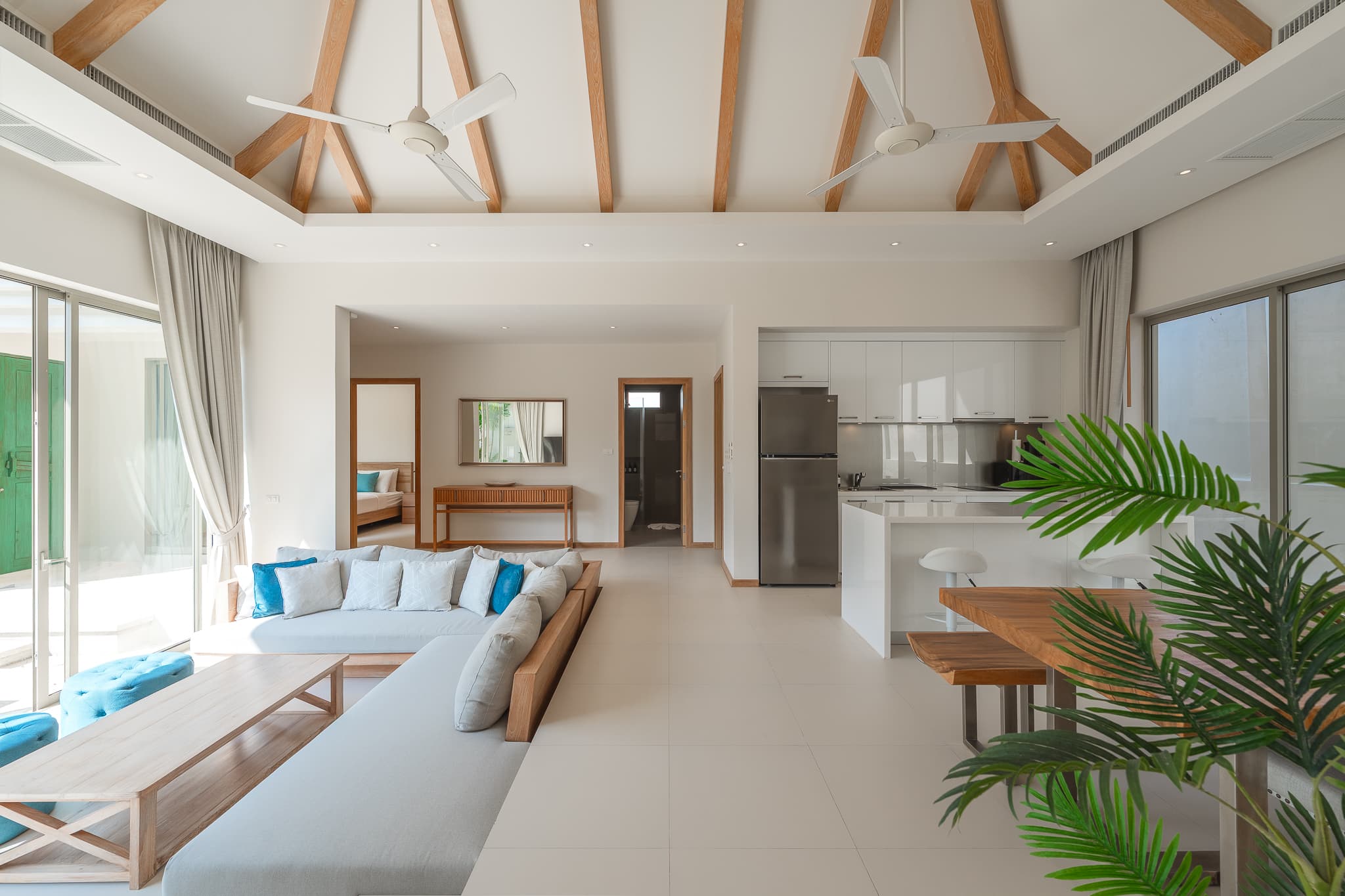
New-build handover
Off-plan villa handover in Phuket: the snagging inspection
A new villa is not a finished villa. Handover is the last moment at which you hold real leverage, and the first monsoon is the test it has not yet taken.
The moment itself
What handover actually is.
Completion means the payment is due. It does not mean the house has been lived in.
The developer’s definition of finished is not yours
On handover day nothing has been tested by use. The pool has been filled once. Nobody has run three showers and a washing machine together, or shut the house up for a fortnight in August. Most of what goes wrong in the first year is invisible that morning.
Handover is when you have leverage
The final payment is what the developer wants, and it is released when you sign acceptance. Before you sign, an unresolved item is their problem. Afterwards it becomes a request, queued behind the next phase of the project. Nothing about the building changes in that hour. Everything about who is chasing whom does.
Walk the house at the hours you will use it
The render faced the view. The built house sits on a real plot, with a boundary, a neighbour and a sun that moves. Come at four in the afternoon and find which terrace is unusable without shade. Then look at the plot next door. It will not stay empty.
The inspection, part one
What to check on the building.
Roughly in the order the rain will find them.
Terrace falls, and where the water is meant to go
Carry a bucket of water onto every terrace and pour it out. It should leave within seconds, towards a drain, never towards a door threshold or a sliding track. A terrace that holds a shallow puddle from a bucket will hold a deep one in September, and that water eventually finds its way inside.
Waterproofing, at the junctions
Membranes rarely fail in the middle. They fail where a flat roof meets a parapet, where a planter sits on a slab, where a downpipe passes through. Ask what was specified, who applied it, whether it was flood-tested, and how long the applicator’s warranty runs. Get it on paper at handover.
Tiles, grout and the sound they make
Tap along every tiled floor with a coin. A hollow note means the tile was bedded badly and will lift, usually under a bed or under a guest. Check grout lines for hairline cracks, silicone in the wet rooms, and movement joints on long terrace runs. Cheap to correct now, disruptive once you are letting.
Timber, humidity and what lives in the ground
Humidity here does not sit still, and neither does joinery. Test every door with the air conditioning off and the house shut, which is how it spends most of its life. Check that sliding panels run without lifting and that insect screens seal. Then ask what termite treatment went into the ground before the slab, and when the next one falls due.
The inspection, part two
What to check on the systems.
Where the money is, and where a shortcut is hardest to see.
The pool, and the room behind it
Look past the water. Open the plant room and go through the pump, the filter, the timer, the salt cell if there is one, and the balance tank if the pool has an overflow edge. Check where the backwash discharges, and listen to the pump from the nearest bedroom at night.
Air conditioning, and whether it was sized for the room
Units get specified from a floor plan, and a plan does not show a west-facing wall of glass. Ask for the capacity of each unit against the room it serves, then run everything at once at two in the afternoon. Follow the condensate drains too: a line laid with no fall shows as a ceiling stain within one wet season.
The consumer unit and the earth
Open the board. Circuits should be labelled, breakers should match what they protect, and the residual current device should trip when tested. Then ask about earthing: an earth rod, a recorded test result, and bonding of the pool, the pump and the metalwork. A house full of water with a casual attitude to earthing is the one dangerous item here.
Water: source, tank and pressure
Ask what the villa actually drinks. Estates here run on mains supply, on a well, or on delivered tankers, and the tank you were given was sized for one of those answers. Check it is sealed against surface water and insects, that the booster pump does not short-cycle, and that pressure holds with three showers running.
The list
Writing snags so they get done.
A vague list gets argued with. A specific list gets done.
Write it so it survives six months
Go room by room. Number every item, describe it in one sentence, photograph it with something for scale, and record the date. Keep it as one document, send it in writing, and note what changes at each visit. Six months on, the conversation will not be remembered the same way by both sides.
What a developer will fix without much argument
Anything cheap, defined and clearly below the specification. Paint, a chipped tile, a door that binds, silicone that has already shrunk, a missing insect screen. Put these on the list even when they feel petty. Small items get conceded quickly, and a list made only of large claims tends to stall entirely.
What they will not fix, whatever you write
Design decisions. If the air conditioning is undersized but installed exactly as specified, if the terrace drains where the drawing said it would, if the plunge pool falls into shade from two o’clock, those are not defects. That is the house you bought. Separate your defects from your dislikes early.
Afterwards
The keys, the rain, and the year that follows.
The defect period runs from handover day, whether or not anyone is in the house.
What to collect before you sign
Warranties with their start dates, appliance manuals, the as-built drawings showing where water, waste and electrical runs actually go, contacts for the trades, every key, every remote, gate and alarm codes. Check the electricity and water accounts are in your name rather than the project’s. A year later you will be chasing a team that has moved on.
The first monsoon is the real inspection
May to October is when the building tells you the truth. Rain finds the junction that was rushed, humidity finds the timber that was never sealed, and the terrace that looked flat reveals which way it truly falls. Damp patches, mould in a wardrobe, a door that no longer closes.
Keep some of the defect period in hand
The useful part of your defect period is the part that overlaps a full wet season. Hand over in December and the house behaves impeccably for months while the clock runs down in dry weather. Book a second inspection for September rather than for the week the period expires.
Straight answers
What new owners ask us after handover.
When should the snagging inspection happen?
How long is the defect liability period on a new villa in Phuket?
Can I start letting the villa straight after handover?
The developer is ignoring my snag list. What now?
I do not live in Phuket. Who watches the villa in the first year?
Reviewed . We update these pages when the practice on the ground changes, not on a schedule.
Where to go next
Our services
- Villa management in Phuket
- Condo management in Phuket
- Airbnb management in Phuket
- All property management services
- Villa care for absentee owners in Phuket
- Rent out my villa in Phuket
- A second opinion on how your villa is being managed
- Villa maintenance and housekeeping in Phuket
- Home property management in Phuket
- About Phuket Property Manager
- Contact a property management company in Phuket
Guides for owners
- Employing villa staff in Phuket
- How to choose a property management company in Phuket
- Self-managing versus hiring a property manager in Phuket
- Short-term rental rules in Phuket: the 30-day question
- Your rental guarantee is ending. What now?
- Switching property manager in Phuket
- Property management fees in Phuket
- The true cost of running a villa in Phuket
- Property management in Phuket for foreign owners
- Mould and humidity in an empty villa in Phuket
- Water in a Phuket villa: the tank, the pump and the day it runs dry
- Salt corrosion in a coastal villa in Phuket
- Villa air conditioning in Phuket: servicing, faults and who pays
- Villa pool maintenance in the Phuket rainy season
Talk to the person who would look after your property.
No call centre, no sales team. We keep the portfolio small on purpose.