Home management
Home property management in Phuket
Every management company publishes the same list of services. This page is the other thing: what someone actually does to your house, in what order, in which month, and what happens when they find something wrong.
The round
What actually happens when someone visits your house.
A visit is either a walk-through with a written record at the end, or it is a photograph of your front gate taken from the car. The difference is invisible from abroad, which is why it needs describing.
A fixed route, so nothing gets skipped
The round runs in the same order every time: roof line and gutters first while the tiles are still dry, then the boundary and the ground, then the plant room, then the house room by room with the wet areas last. Order matters because memory is not a method. A fixed route means the thing looked at in March is the same thing looked at in September, and two different people report the same house the same way. It also means the dull corner nobody enjoys checking still gets checked.
Things get opened, not glanced at
Under every sink, behind the wardrobes, inside the cupboard holding the water pump, the cover of the consumer unit, the back of the outdoor kitchen. Most failures in a house here announce themselves somewhere nobody looks: a damp ring under a trap, a green crust on a terminal, a slow drip that has been going for a month. Taps and showers get run so the traps do not dry out and send the drains back up into the bathroom.
Machines are run under load
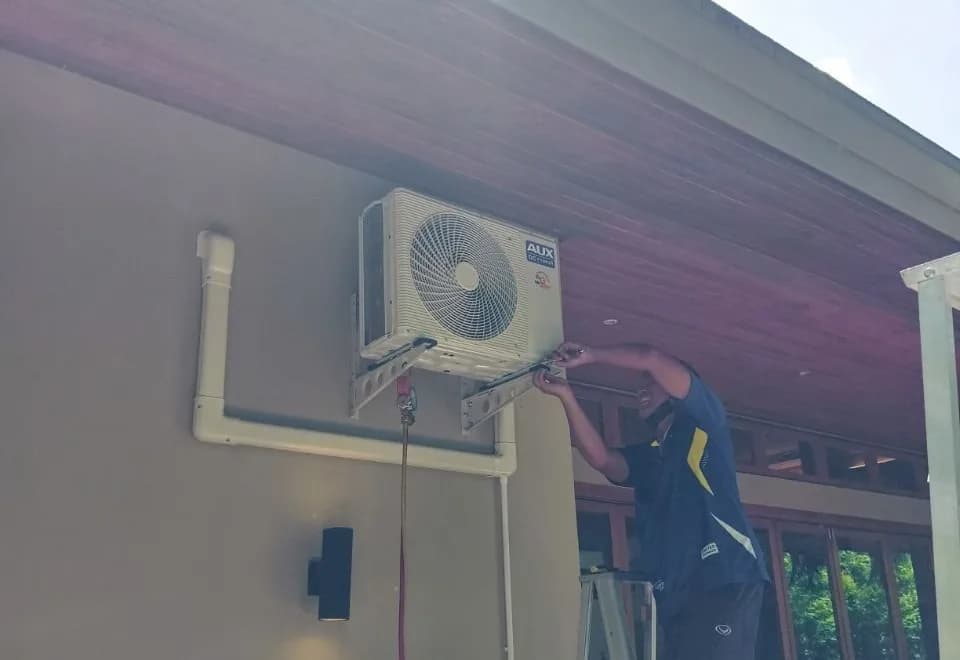
A photograph of an air conditioner proves nothing. Each unit is run long enough to cool the room, and its condensate drain checked. A blockage there arrives as a stain on a bedroom ceiling, not as an aircon fault. The pool pump, the water pump, the gate motor and, where there is one, the generator all get started, because a compressor that starts hard or a pump that whines on the seal tells you something months before it stops. If there is a car, it gets run too.
Meters, and the leak nobody can hear
Water and electricity readings go into the report every visit. With the house closed and nothing running, a water meter that keeps creeping means a leak underground or a cistern valve passing quietly into the pan. That is the cheapest fault in the world to find this way and one of the most expensive to find by receiving the bill. Electricity readings do the same job for a freezer nobody knew was still on.
Dated photographs and a written note
The same angles each visit, so change is visible rather than argued about. Anything found gets a photograph, a location, a probable cause and a recommendation, not a line saying “maintenance carried out”. The report goes out whether or not anything happened, because the visit where nothing was wrong is precisely the one you are paying to be sure about.
Rain, salt and soil
Three things here damage a house faster than people do.
Owners brace for guest damage. In Phuket the weather and the ground do more, and they work on the house whether or not anyone ever stays in it.
Humidity, from May onwards
Through the wet months the air stays saturated for weeks at a time, and a closed, still room is where mould starts: the back of a wardrobe, the lining of a curtain, leather, the cool side of an external wall. The work is unglamorous. Open the house and get air moving on every visit, run the units on dry mode, keep wardrobe doors ajar, put a dehumidifier where the air never moves. Caught in the first weeks it wipes off. Left a whole season it is in the foam and the plaster, and then it is a replacement rather than a clean.
Salt, if you are anywhere near the coast
Onshore wind carries salt further inland than owners expect, and it goes after the small metal parts first: hinges, screws, gate motor rails, outdoor light fittings, the fins on an aircon condenser, and stainless steel that turns out not to be. The fixing usually fails before the thing it holds, which is why a rusted bracket on a balustrade is a safety item and not a cosmetic one. Fresh water rinses on exposed hardware, and treating a mark when it appears rather than when it spreads, is most of the defence.
Termites work from underneath
They come up out of the soil in mud tubes along foundations and the outside of walls, then into door frames, skirting and anything timber that touches the ground. Nothing shows until something gives, so the round includes sounding the vulnerable timber and walking the base of the walls looking for tubes. Treatment is a standing arrangement rather than a reaction, because a house left quiet for months gives a colony exactly the conditions it wants.
The dry season is the garden’s hard season
From December the rain stops and the problem inverts. Planting that took years dies in a few weeks without irrigation, the lawn burns off, and the pool loses level fast enough to drop below the skimmer and run the pump dry. March and April are the hardest weeks of all. The heat peaks just before the monsoon returns, and that is when a garden that coasted through January gives up. Watering has to be checked rather than assumed, because timers drift after a power cut and a dripline blocks silently. From May it flips back: cutting weekly, clearing what falls, keeping the growth off the paving and the pool coping.
Gutters, tiles and the storm you slept through
A roof leak here almost never announces itself. It starts with a lifted tile, a gutter packed with leaf fall, a silicone seal gone brittle under the sun. The first sign is a stain on a ceiling, by which point the plasterboard has been wet for a while. Gutters get cleared before the season rather than after it, and the roof line gets walked after any serious storm rather than at the next scheduled visit.

The pool
Balanced is a range, not a colour.
The pool is the single largest recurring job on most Phuket houses, and the one where doing it nearly right still ends with a green pool on an arrival day.
What balanced actually means
Free chlorine, pH, total alkalinity, stabiliser, and salt level if there is a chlorinator. They are not independent: let the pH climb and the chlorine you have stops working, let stabiliser build up and it stops working for a different reason. Testing means a proper kit and a logged reading with a date on it, not a look at the water. Anyone can make a pool clear for a day; keeping it in range across a season is the actual skill.
Why testing goes up in the wet season, not down
Owners assume rain does the work. It does the opposite: a heavy afternoon dilutes the water, moves the pH and washes garden debris into the surface, and the sun the following morning burns off what chlorine is left. Swimmers, sun cream and insect repellent consume chlorine on top of that, and a house that sits quiet through September can be full again by November. This is why a fortnightly schedule set in the dry months, when the water sits stable for days at a time, is not the schedule the wet season needs.
The room behind the pool
Filter pressure read and the filter backwashed when it rises, salt cell inspected for scale, pump seal checked for the weep that precedes a failure, skimmer baskets emptied, waterline scrubbed before it stains permanently. The detail that catches everyone: after a power cut the timer clock resets, so the pump quietly stops running its cycle and nobody notices until the water goes. Checking that clock costs seconds.
A green pool is not a service call, it is a lost booking
Left alone in the heat a pool turns in about a week, and bringing it back is days of work rather than an afternoon: shock, filter, brush, re-test, repeat. If that week ends on a guest’s arrival day, no amount of apologising fixes the review, and if the level dropped below the skimmer while the pump kept running, the pump is now part of the job as well.

When it breaks
The air conditioning fails on a Sunday afternoon.
This is the part owners are really buying, and the part that is impossible to judge from a website. Here is what the first hour looks like.
Someone picks up, then triages
Before anyone calls a technician: is it the unit, the breaker, or a blocked drain shutting it down on a float switch. A good part of the Sunday aircon calls we take are not a failed unit at all, but a tripped breaker or a condensate line backing up and stopping the unit on its float switch. Knowing that is the difference between a fixed room and a wasted afternoon. If it is the unit, the immediate job is comfort while the repair is arranged: a portable unit, or moving people into another bedroom. The repair is the second problem, not the first.
The power cut, and the breaker nobody reset
Cuts are routine in storm season, and a breaker that trips during one stays tripped until a person stands in front of it. That means a freezer defrosting in the heat, the pool pump off, the dehumidifier off, the gate motor dead and an irrigation timer that has forgotten what time it is. Most houses here have no generator, so the recovery is entirely manual: someone has to stand at the consumer unit, reset what tripped, restart the pump, put the clocks back and decide what in the freezer is still safe. Where there is a generator it has to be run under load now and then, or it will not start on the night you need it. After a serious storm the house gets checked, whether or not a visit was due.
Parts come from Bangkok
The number that hurts is not the repair bill, it is the days. A capacitor, a pump seal, a specific filter or a control board often has to be shipped down, which is days rather than hours and longer over a public holiday. That is the argument for knowing before the season which part of your kit has a long lead time, and for holding the cheap consumables on the shelf: filters, seals, capacitors, lamps.
What we do with damage we find
It gets photographed, located, and written up with a probable cause and the options, including the option of leaving it alone until you are next here. Anything above the spending limit you set goes to you with a quote before work starts. Anything below it is simply done, and it appears on your statement as its own line with the invoice behind it. A repair that reaches you as a summary line, months later, is the thing this arrangement exists to prevent.
A second quote is not an insult
For anything structural, anything involving the roof, or anything where the first number surprises us, we get more than one quote and you see both, including the one we would not have chosen. Ask any manager how they select contractors and whether you see the original invoice. The answer to that second question tells you most of what you need to know about how repairs will be billed to you.
The empty house
Looking after a house nobody is living in.
A house owned from abroad tends to sit empty for long stretches, and the longest of them usually fall in the wet months, when the owner is at home in a northern summer. An empty house is not a house at rest. It is a house with nobody in it to notice things.
A house that reads as abandoned invites attention
Uncut grass, a pile of flyers at the gate, bins never moved, shutters closed for months: that combination is legible from the road, and it is what makes a house look like an easy one. Keeping the garden cut, the entrance cleared and lights on timers is a security measure as much as a cosmetic one. Visits at irregular hours are worth more than visits at the same hour each week, for the same reason.
Post, notices and the bill that cuts your water off
Utility bills arrive on paper here, estate and building notices arrive on paper, and both are cheerfully indifferent to your being in another hemisphere. An unpaid water bill ends with the supply disconnected and a reconnection to arrange in person. Collecting what arrives, paying what is due and telling you what was in the envelope is unglamorous and it is most of the value in the first year.
The things you do to a closed house
Run every tap and flush every pan so the traps stay wet, because a dry trap is an open pipe and the smell that follows takes days to clear. Open the house and cross-ventilate. Lift soft furnishings off cold floors before the wet season, prop the fridge open if it is switched off, take batteries out of anything that will sit for months, and cover what sits under the strongest light. None of it is difficult. All of it has to actually be done.
We are not a security company
We hold keys, we visit, we notice what changed, and we are the people your neighbour or your estate office calls. We do not provide guards, alarm response or camera monitoring, and a manager who implies otherwise is selling you something they cannot deliver at three in the morning. Where your estate has its own security we work with it; where you want a manned presence we will tell you who to speak to and take nothing for the introduction.

When guests are in it
The half of the job the building never sees.
If the house earns, everything above still has to happen, and it has to happen between arrivals, in the hours nobody is watching.
The arrival, in person
Someone meets the guest, walks them through the house, shows them which remote does what, explains the pool, the gate, the road and where to eat. It sounds like hospitality theatre. It is actually the cheapest maintenance you will ever buy: the guest who was shown how the aircon works does not leave it running at full with the doors open for a week, and the guest you have met behaves differently towards the house. It is also when the immigration reporting for foreign guests gets done rather than forgotten.
During the stay, one number that gets answered
Problems in a rented house are not measured by size, they are measured by how long the guest sat with them. A blown lamp fixed the same afternoon never existed. The same lamp on the fourth day is a sentence in a review that costs you bookings for a year. What matters is not a promise of availability but who physically picks up, and whether that person can send somebody to the house today.
Checkout, walked before the cleaner starts
The house is inspected the same morning, not at the next scheduled visit: a look for damage, a count of what should be there, photographs of anything that changed. Doing it before the clean is deliberate, because once the room is reset, nobody can say when the mark appeared. This is also the moment a fault gets caught before the next guest inherits it.
The turnaround, which is also an inspection
Beds, bathrooms, floors, glass, pool furniture, fridge emptied, linen changed, consumables restocked, worked against a written checklist and photographed at the end so the work is a record rather than a claim. Housekeepers find more faults than anyone else in this business, because they are the only people who touch every surface in the house. What they find should reach you, not just the office.
Damage: what gets charged, and what does not
A chipped glass and a stained towel are operating costs, not damage, and chasing a guest for them buys you a bad review for nothing. A cracked hob, a burnt worktop or a broken sun lounger is different. It needs photographs, a checkout timestamp and a plain explanation to the guest, and all of it has to be raised with the platform before the next guest checks in, which on a high-season villa turning around the same day is a matter of hours, not days. That deadline is the real reason the checkout walk happens before the cleaner starts rather than after. With the evidence attached and the tone kept level, most guests pay.
Distance
How far away your manager sits decides how the service feels.
Phuket looks small and crosses slowly. Travel time, not a coverage map, is what determines whether a problem is handled today or tomorrow.
Ask for the travel time, in writing
A company will tell you it covers the whole island, and it may be true. But ask how long it takes one of their people to reach your gate at five in the afternoon, and how many other houses that person is responsible for. Those two answers predict your experience better than anything on a services page. We work across the whole island of Phuket, and we will give you both numbers for your address before you sign anything.
A villa and a condo are not the same job
In a condominium the juristic person sets rules you have to work inside, and the building already does part of the work: the common areas, often the security, sometimes the pool. A house has none of that. Everything from the roof to the gate motor is yours, which is why home management on a villa is a standing programme and on a condo it is a shorter, sharper list.
The same faces, not a rota
We are a small company, deliberately. The practical consequence is that the person who inspects your property is the person who was there last time and remembers the stain that was not there in April. The honest cost of that is bench depth: a large operation has more people to send when three things happen at once. Both are real, and which one suits you depends on how much you value continuity.
Being straight about it
When you do not need a management company.
We would rather say this here than take on a house where we add nothing.
You live here, or nearly
If you are on the island most of the year, in the same part of it as the house, and you do not mind the phone calls, you can do this yourself. What a manager sells is mostly presence and a contractor list, and you can build both. The point at which it changes is usually the point at which the house starts earning, or you start travelling.
Your estate already does half of it
Some developments cut the gardens, run security and service the common pool as part of the estate fee. If yours does, you do not need a full programme layered on top of it. You need the gaps covered, usually the inside of the house, the machines, the bills and someone to open the door to a contractor. Pay for what is missing, not for a package.
A caretaker may be enough
If the house never earns and you visit often, a trusted caretaker who lives nearby and a good pool technician may cover it. What you give up is the written record, the purchasing discipline and someone to hold when a job is done badly. That is a fair trade for some owners and a bad one for others; it depends on whether you can tell good work from bad at a distance.
We are not a construction company
On roof replacement, structural work or a full renovation, we will run the tender, hold the contractor to the scope and inspect the work, or we will tell you plainly that the project needs a builder and a project manager rather than us. A management company that says yes to everything ends up supervising trades it does not understand, at your expense.
Straight answers
What owners ask us about looking after a house here.
What does home property management in Phuket actually include?
How often should someone visit my house?
My house is never rented. Is management still worth it?
Who chooses the contractor, and how do I know the price is fair?
Do you hold keys, and who has access?
Can you look after the house and let it as well?
What happens if something serious goes wrong and I cannot be reached?
Reviewed . We update these pages when the practice on the ground changes, not on a schedule.
Also worth reading
Our services
- Villa management in Phuket
- Condo management in Phuket
- Airbnb management in Phuket
- All property management services
- Villa care for absentee owners in Phuket
- Rent out my villa in Phuket
- A second opinion on how your villa is being managed
- Villa maintenance and housekeeping in Phuket
- Home property management in Phuket
- About Phuket Property Manager
- Contact a property management company in Phuket
Guides for owners
- Employing villa staff in Phuket
- Off-plan villa handover in Phuket: the snagging inspection
- How to choose a property management company in Phuket
- Self-managing versus hiring a property manager in Phuket
- Short-term rental rules in Phuket: the 30-day question
- Your rental guarantee is ending. What now?
- Switching property manager in Phuket
- Property management fees in Phuket
- The true cost of running a villa in Phuket
- Property management in Phuket for foreign owners
- Mould and humidity in an empty villa in Phuket
- Water in a Phuket villa: the tank, the pump and the day it runs dry
- Salt corrosion in a coastal villa in Phuket
- Villa air conditioning in Phuket: servicing, faults and who pays
- Villa pool maintenance in the Phuket rainy season
Areas we cover
Residences we already work in
- Anchan Villas: property management for owners
- Botanica villas: property management for owners
- Ayara Surin: property management for villa owners
- Wallaya villas: property management for owners
- Laguna Park: property management for owners
- Two Villas Tara: property management for owners
- The Ozone Residences: property management for owners
- Aristo 2 condo, Surin: Phuket Property Management
- The Regent: Phuket Property Management
Talk to the person who would look after your property.
No call centre, no sales team. We keep the portfolio small on purpose.